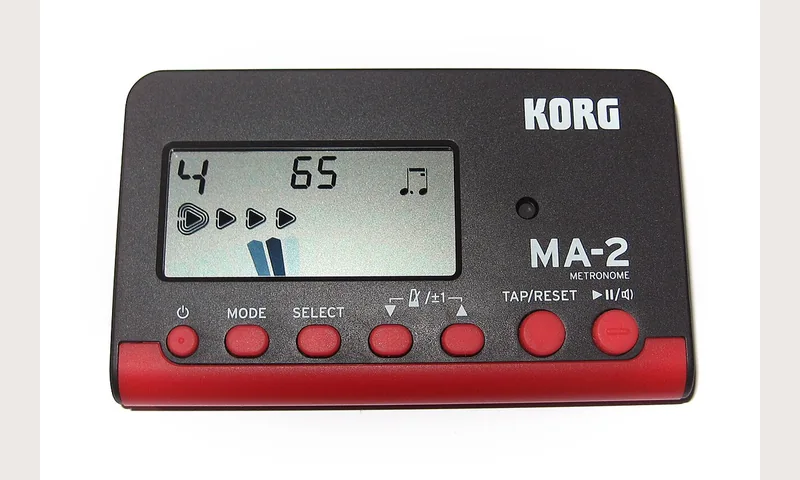
The short answer
The click is a reference point, not the complete rhythm. Counting subdivisions helps keep offbeat notes in a stable position.
What to do
- Start with quarter-note clicks and speak even subdivisions. Keep the voice steady before adding the instrument.
- Play a simple pattern while alternating spoken and silent counting. Record a short example.
- Reduce the number of audible clicks only when the original pattern is stable. Restore frequent clicks when you lose your place.
Choose one counting system
Begin with a beat you can feel comfortably and speak the intended subdivision over it. Clap or tap before adding a complex instrument pattern. Make clear which click represents which part of the measure. Confusion about the metronome assignment can make an otherwise steady exercise feel wrong, especially when changing between quarter-note and half-time clicks.
Keep accents separate from note spacing
Play the subdivision evenly, then add the musical accents without shortening the gaps around them. Record a short phrase and listen back rather than judging only while playing. If one hand or note group consistently leads, simplify the movement and compare again. The metronome is a reference; it cannot tell you by itself whether the phrase has useful dynamics.
Reduce support after stability improves
Try fewer clicks or short silent gaps when the basic pattern feels secure. Return to a denser click if the exercise becomes guesswork. Compare where you land when the click returns, then work on the specific weak transition. Keep the task short enough to sustain attention and avoid making harder click settings the only measure of musical progress.
Check the result
Listen for notes consistently landing early or late, including the return after silent beats.
Know the limits
A metronome cannot judge tone, phrasing or physical tension. Keep the exercise short enough to listen actively.
Further reading
Sources for the connections and technical principles discussed above. The diagnostic sequences are our editorial explanation. Consult the manual for your exact model before changing hardware or settings.
These are general educational guides, not hands-on product reviews. How we prepare our content. Cover photo source & license.
Keep working on your setup
Build a practice session around one problem
Define a result you can hear.
Read the guide
Use slow practice without losing the groove
Keep the relationships between notes intact.
Read the guide
Learn a song by mapping its sections
Build a map before memorising every detail.
Read the guide