Separate the pitches of two rack toms
Give adjacent toms distinct voices without forcing either drum beyond its useful tuning range.
The short answer
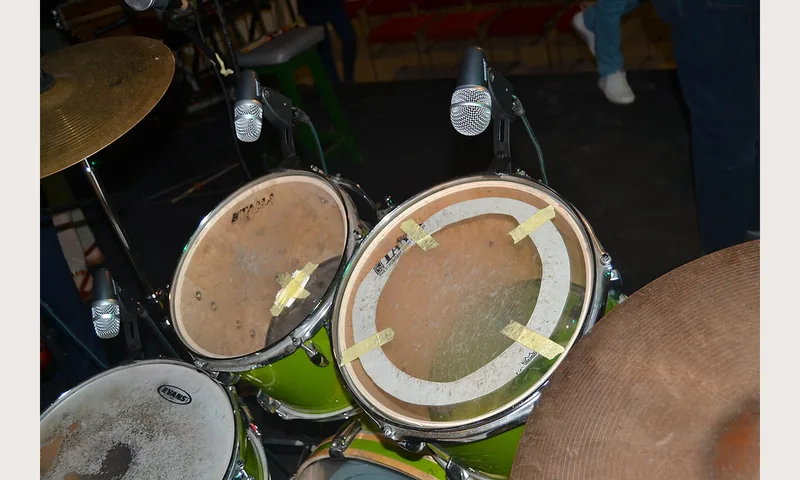
Two toms can sound alike because their pitches overlap, but also because one has a vague, uneven note. Tune each drum to a clear sound first, then choose a separation you can hear in a fill. There is no requirement that every kit follow a fixed musical interval.
What to do
- Remove temporary muffling and play each tom separately at a similar force. Identify whether the confusion is pitch, excessive sustain, or a rattle shared by both drums.
- Even the near-lug notes on the batter head of the first tom. Check the resonant head separately, supporting the opposite head lightly when you need to hear one at a time.
- Find a comfortable range for the second tom using small, balanced adjustments. Stop lowering it if the head develops a papery flap or stops responding to gentle strokes.
- Alternate single strokes between the toms, then play a short descending fill. Change only one drum at a time so you can judge which adjustment creates useful separation.
- Put back only the damping the music needs. Recheck the pair from a few steps away as well as from the stool, since the player hears a different balance.
Choose an interval by musical use
For a simple descending fill, a clear high-to-low movement may matter more than matching the song key. Play the rhythm you actually use, including flams or doubles, before choosing a final interval. Closely spaced notes can work in a larger melodic kit, while two toms in a compact kit may benefit from a more obvious step. Keep the decision tied to what the part needs.
Judge decay as well as pitch
A long ring from the first tom can cover the second tom even when their initial pitches differ. Listen to the space after the fill. If notes blur together, explore the relationship between each drum's two heads or add a small removable damper to the problem drum. Avoid muting both heavily simply because one note is lingering. A distinct attack and a controlled tail are separate targets.
Use a repeatable phrase
Choose a phrase with one hit per drum followed by a pause, then a denser fill. Keep stroke height reasonably similar throughout the comparison. Record each version with a spoken label so you do not lose track of changes. If a pitch adjustment improves the isolated notes but makes the full kit awkward, restore the earlier setting and try the other tom instead.
Check the result
A listener should distinguish the two drums in a short fill without seeing which one you strike. Quiet notes should remain clear, and the lower tom should have a definite centre rather than only a brief thud.
Know the limits
Exact lug frequencies and intervals do not transfer reliably between different shells, heads and mounts. If both drums have nearly identical dimensions, the available contrast may be smaller than on a wider size pairing.
Further reading
Sources for the connections and technical principles discussed above. The diagnostic sequences are our editorial explanation. Consult the manual for your exact model before changing hardware or settings.
These are general educational guides, not hands-on product reviews. How we prepare our content. Cover photo source & license.
Keep working on your setup
Check phase in a two-microphone drum recording
Compare the microphones together, not only in solo.
Read the guide
Recover a rack tom that loses sustain on its mount
Compare the drum on and off its support before changing heads to cure a choked rack tom.
Read the guide
Make a two-beat fill fit the end of a bar
Keep the first half of the measure intact and enter the fill at a defined point.
Read the guide