Place stereo overheads for a stable drum image
Keep the snare anchored while the rest of the kit has a clear place in the stereo field.
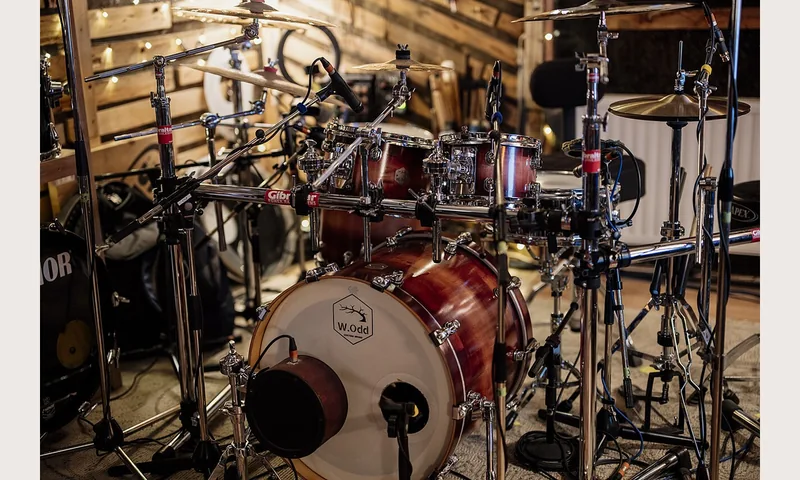
The short answer
Choose a stereo method deliberately, position it around the desired kit perspective, and listen to both stereo and mono before tracking. Evaluate the whole groove instead of judging only the width of isolated cymbals.
What to do
- Choose the audience or drummer perspective for the recorded stereo picture.
- Select a documented overhead arrangement suitable for your microphones and room.
- Record snare hits, cymbals, a groove and a slow tom fill.
- Listen for a stable center and a natural progression across the kit.
- Check mono compatibility and revise the placement before setting final levels.
Define the center musically
The snare usually supplies a useful center reference, but the best physical center of an overhead arrangement is not automatically the midpoint between cymbal stands. Listen to where the snare appears and how its tone changes between channels. Keep a note of the arrangement so later microphone moves are deliberate and can be reversed if the original perspective was stronger.
Understand the chosen method
Coincident, near-coincident and spaced arrangements create stereo information differently. Capsule orientation, spacing and polar pattern all matter. Use the relevant manufacturers explanation to establish the geometry. Avoid combining fragments of several methods without checking the result; a visually symmetrical setup can still produce an uneven or unstable image because the drums are not symmetrical sources.
Check a moving performance
A slow fill exposes gaps and sudden jumps more clearly than a wash of crashes. Ask the drummer to play each tom and both main cymbals, then a normal groove. Listen for an instrument pulling unexpectedly to one side or becoming thin when the channels are combined. Move the pair in small steps and record each meaningful comparison with a spoken or written label.
Judge width against coherence
A very wide image can sound exciting alone but distracting in a dense arrangement. Bring in the kick, snare close microphone and other instruments before committing. Use mono as a diagnostic, not a demand that stereo and mono sound identical. A major loss of a key drum deserves investigation; modest changes in room character may be acceptable for the intended production.
Check the result
Compare the final stereo and mono test at similar loudness. The snare should remain convincing, the tom sequence should have a predictable path, and no essential instrument should nearly disappear when combined.
Know the limits
No single overhead spacing works in every room. Stereo technique does not replace checking placement, polar patterns, room reflections and the actual performance.
Further reading
Sources for the connections and technical principles discussed above. The diagnostic sequences are our editorial explanation. Consult the manual for your exact model before changing hardware or settings.
These are general educational guides, not hands-on product reviews. How we prepare our content. Cover photo source & license.
Keep working on your setup
Set bass drum spurs for a stable playing position
Keep the bass drum stable using the spurs and a suitable floor surface.
Read the guide
Set a drum throne for stable foot control
Use balance and pedal access to choose a practical starting seat position.
Read the guide
Find a stable audio buffer size
Balance monitoring responsiveness against processing headroom.
Read the guide